
Most people who grew up on Pokemon Red and Blue have a shoebox somewhere. It gets dug out when a friend mentions a Charizard selling for a silly amount, and the first instinct is to type the name into eBay and read the biggest number on the page. That number is what one hopeful seller is asking for. It may have sat there unsold for a year, and it tells you almost nothing.
Working out a real value is more side quest than boss fight. There are a few checks to run, each one narrows the range, and by the end you’ve got a figure you could actually sell at.
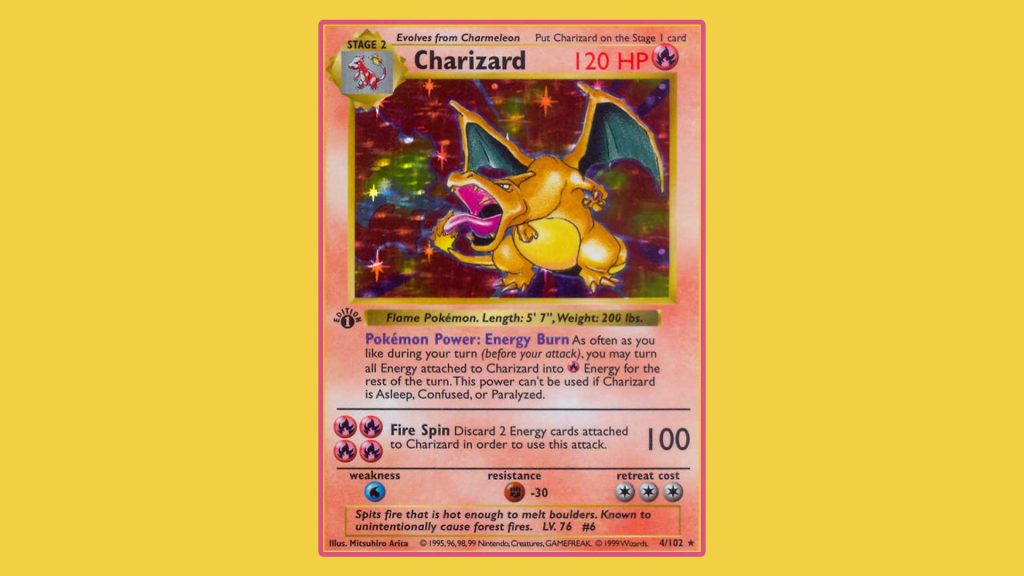
Base Set Charizard, 4/102. The same artwork exists as 1st Edition, Shadowless and Unlimited printings, and each one is a different card to the market.
1. Identify the exact card, not just the Pokemon
Two cards can share a name and artwork and still be worth wildly different amounts. What matters is the set symbol (bottom right on older cards, next to the number on newer ones), the card number, whether there’s a 1st Edition stamp, and whether it’s a holo. On the original Base Set you also need to check for Shadowless, which means no drop shadow down the right side of the art box. Write all of it down before you look up a single price, and photograph the front and back while you’re at it. You’ll want the pictures for the next step.
Searching for “Charizard” gets you every Charizard ever printed. Searching for “Charizard 4/102, Unlimited, holo” gets you the one you’re actually holding.
2. Grade the condition honestly
Condition is where most home valuations go wrong, because everyone thinks their own cards are mint. The market uses five tiers: Near Mint, Lightly Played, Moderately Played, Heavily Played and Damaged. The Pokemon card condition guide on CardTrack walks through each one with photos and shows what each step down does to the price in real sales. It’s worth reading once before you sort a pile.
The quick version: tilt the card under a lamp and look for scratches on the holo foil, then check the corners for white wear. Turn it over too, because the blue back shows edge whitening far more clearly than the front does. Any crease, even a faint one you can only see at an angle, drops a card out of the top two tiers. You’ll want to go easy on your own cards here. Don’t, because the buyer won’t.
3. Use sold prices, never asking prices
This is the single biggest fix. On eBay, open the filters and tick “Sold items”, and suddenly you’re looking at what people actually paid rather than what sellers hoped for. Scan the last few weeks, ignore the odd result that’s miles away from the rest, and find where the middle of the cluster sits for a card in your condition.
If that sounds like homework, it is, which is why price guides exist. CardTrack does this step for every Pokémon card. It takes real eBay sold results and Fanatics auction results, blends them into one price for the raw card and another for each graded version, then cross-checks the figure against live TCGplayer and Cardmarket listings. So the number you see comes from completed sales rather than from what someone happens to be asking.
4. Keep raw and graded prices apart
A card in a plastic slab with a PSA, BGS or CGC grade on the label trades in a separate market from the same card loose. A PSA 10 is a different product to a Near Mint raw copy, with its own buyers and its own price history, so don’t price a loose card off graded sales and assume the gap is yours.
Grading costs money and takes weeks, and the card still has to earn the grade when it gets there. For most cards in most collections the raw price is the honest one. If you’re tempted anyway, start with one card rather than the whole pile, and only bother where the graded price comfortably clears the fee. That’s a decision to make after you know the raw value, not before.
5. Read the trend, not the spike
Pokemon card prices move with the wider franchise. A new mainline game or a pack-opening video that goes viral can lift a card for a few weeks before it settles back down. It works the other way too: a card that’s drifted down for months isn’t suddenly worthless because one listing closed low. Look at a few months of history before you decide what a card is “worth”, and treat a sudden jump as a reason to wait rather than a new floor.
What to do with the number
Once you’ve got a real value, sleeve and toploader anything above pocket-money territory, because condition is the one variable you actually control. Keep a simple list too: what you own, the condition you gave it and the value on the day you checked. It’s dull, but it’s exactly what you’ll want for insurance or when you come to sell. And don’t take the first offer from the first person who hears you’ve got old cards. You now know more than they’re hoping you do.
Your shoebox probably doesn’t hold a retirement fund. It very likely holds a few cards worth more than you’d expect and a lot that are worth about a coffee. Knowing which is which is most of the job, and surprisingly few people ever bother to learn it.