NVIDIA’s delayed GeForce Now service is finally coming to India. Nearly nine years after Nvidia first announced its premium cloud gaming platform, the service is now set to transform how Indian gamers play AAA titles. However, its success will largely depend on pricing, performance, and real-world user experience.
GeForce Now was first launched in India in 2017 at ₹650 per month, but it eventually disappeared quietly. At the time, cloud gaming was still in its early stages and struggling to gain traction across the Indian subcontinent. Fast forward to 2026, and a lot has changed. The service was later re-announced at CES 2025, then delayed by another year and pushed to Gamescom, missing the November 2025 deadline. This time, however, Nvidia finally appears ready to bring its cloud gaming service to Indian shores, as showcased during a recent early preview held in Mumbai in 2026.
Geforce Now Early-Preview
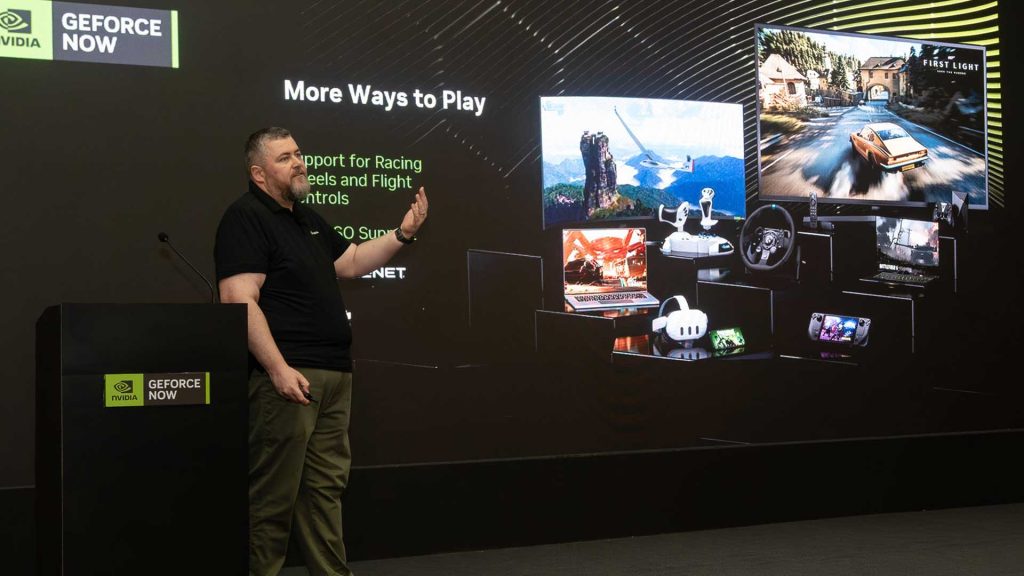
On February 6, 2026, Nvidia held a preview event in Mumbai that offered a first-hand experience of the service running on Indian servers. Instead of relying on third-party partners, Nvidia is now aiming to deliver the service directly using its own data center infrastructure in India. What we witnessed was an impressive cloud gaming experience that could, in the future, reduce the necessity of buying expensive gaming PCs.
The crucial difference that sets GeForce Now apart from competitors like Xbox Game Pass is that you are not paying for the games themselves. Instead, you are effectively renting access to cutting-edge hardware that streams games directly to your device. The games you already own – on platforms like Steam, Epic Games Store, Xbox, or Ubisoft Connect – can be played through the service.
Traditionally, users must download and install games on their personal devices. However, many modern AAA titles do not run well on standard hardware, which increases the need for expensive, high-end gaming setups to achieve high graphical quality. Without such hardware, the gaming experience can feel compromised.
With GeForce Now, there is no need to invest in expensive gaming hardware. A high-end gaming system is hosted in a nearby server location, such as Mumbai, allowing you to stream games directly in real time. This means users can play games on hardware comparable to an RTX 5080-powered system over the internet, regardless of the device or platform they are using.
Currently, the service supports more than 4,500 games globally, including:
- 180+ Xbox Game Pass titles
- 100+ free-to-play games
- 2,200+ ‘install-to-play’ titles available for Performance and Ultimate tier subscribers
Unlike Xbox Game Pass, which provides access to a rotating library of games, GeForce Now allows you to play titles you have already purchased – including those games sitting unplayed in your Steam library from past sale events.
RTX 5080 SuperPODs in Mumbai
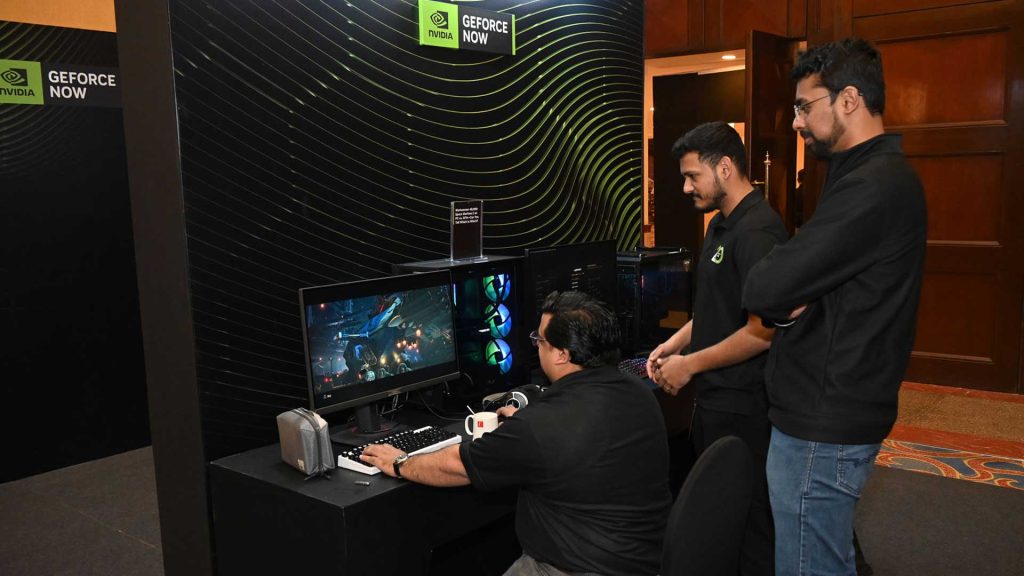
NVIDIA is not cutting corners for the Indian launch. The company is deploying RTX 5080 SuperPODs – the same high-end infrastructure currently used in North America and Western Europe.
With this move, India becomes the third major region globally where Nvidia is operating GeForce Now directly through its own server infrastructure. By removing reliance on local partners, Nvidia’s direct infrastructure investment is expected to strengthen the cloud gaming ecosystem in India, particularly in terms of pricing control, service quality, and accessibility. Here are some of the key features that make the technology impressive.
Advanced Streaming Features:
- Cinematic Quality Streaming (CQS): Supports YUV 4:4:4 chroma sampling, HDR10, and SDR10 for superior color accuracy
- AV1 codec with RPR: 40% more efficient than H.264 at similar quality
- Up to 100 Mbps streaming for crystal-clear visuals
- Cloud G-Sync: Smooths out frame delivery even when streaming
- NVIDIA Reflex: Targets click-to-pixel response times as low as 30 milliseconds
Performance Tiers:
NVIDIA has not yet revealed any official details about pricing tiers or performance plans for India. The tiers mentioned below are based on the global plans that Nvidia currently offers in other regions.
Free Tier:
- 1-hour sessions with ads
- 1080p/60fps streaming
- Access to 2,000+ ready-to-play games
- RTX 3050-class hardware
Performance Tier ($9.99/month globally) :
- 6-hour sessions
- 1440p/60fps streaming
- RTX 3060-class hardware
- Ray tracing and 5.1 surround sound
- Access to 4,000+ games including Install-to-Play
Ultimate Tier – $19.99/month globally (900 approx):
- 8-hour sessions
- 4K/120fps or 5K streaming
- Up to 360 fps support
- RTX 5080-class hardware
- DLSS 4 with Multi-Frame Generation
- Full feature access
Since January 2026, both tiers come with a 100-hour monthly playtime cap. For additional playtime, users must pay $2.99 for the Performance tier or $5.99 for the Ultimate tier for every additional 15-hour block.
The Mumbai Preview
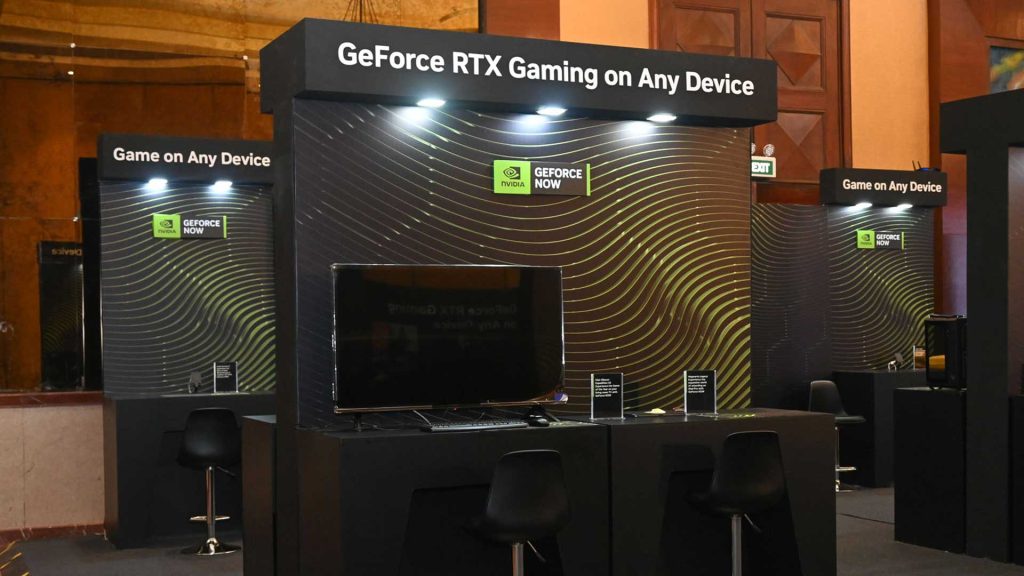
During the media preview, the service was tested across various devices, and the results were impressive.
- Cyberpunk 2077: ~100 fps on PC
- ARC Raiders: Close to 300 fps on high-end monitors
- Black Myth: Wukong: 100+ fps on a MacBook Air
- Hogwarts Legacy: Steady 60 fps on entry-level TVs
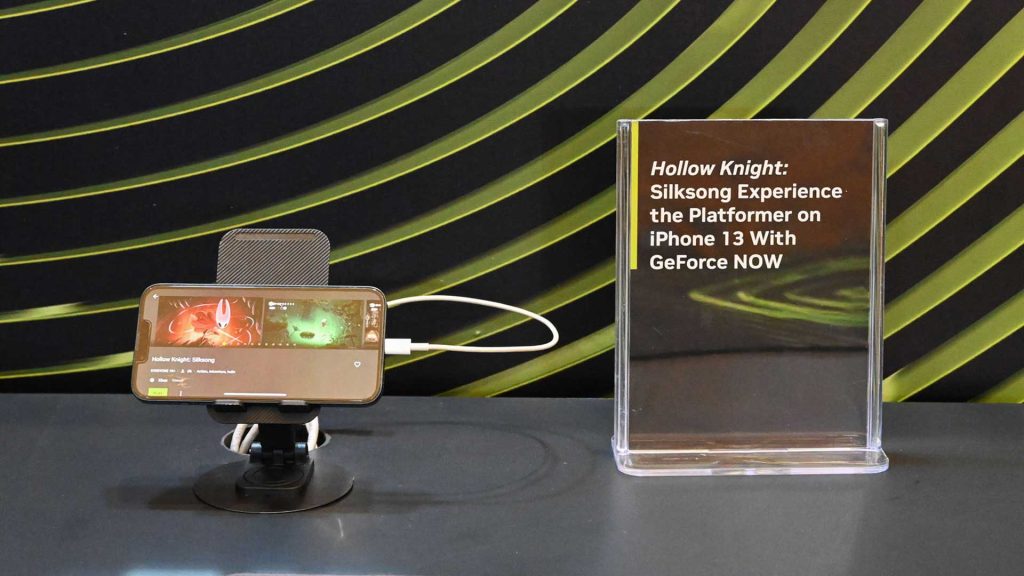
- Forza Horizon 5: 60 fps on smartphones
Latency during testing in Mumbai was extremely low, with ping reportedly around 1–2 ms, which is practically negligible for most gaming scenarios. DLSS 4’s AI upscaling and multi-frame generation further enhanced visual quality, making games look significantly better and smoother. Most of these tests were conducted using wired Ethernet connections in Mumbai – the same city where the servers are currently located. The bigger question is how the service will perform in other regions such as Pune, Kolkata, and Bangalore. If Nvidia plans to deploy local servers in multiple cities, performance consistency is likely to remain high, similar to what was demonstrated in Mumbai.
However, if server infrastructure is limited to select locations, performance may vary depending on the user’s distance from the server and the quality and stability of their internet connection.
Infrastructure Reality Check: The Indian Challenge
India’s internet landscape is complex. On paper, it may look promising. Average download speeds have reached around 50 Mbps, according to Steam telemetry data. Steam’s user base in India has also grown by nearly 150% over the past four to five years. Additionally, the 5G rollout is accelerating, with real-world speeds typically ranging from 100 Mbps to 1 Gbps in select areas. But the ground reality is more complicated. While major urban centers benefit from 100+ Mbps fiber broadband connections, many regions still depend on unstable 4G networks or, in some cases, even 3G connectivity.
Quality inconsistency is another major challenge. A 100 Mbps broadband plan may deliver full speeds during off-peak hours, such as early morning, but can suffer from jitter, latency spikes, and packet loss during peak evening hours when network congestion is high due to streaming and heavy internet usage.
The ‘last-mile’ problem also remains significant in India. Internet quality can vary from building to building, not just city to city. With servers initially expected to be located only in Mumbai, latency performance for gamers in regions such as Northeast India or parts of southern India remains uncertain and will likely depend on network routing quality and ISP infrastructure.
What Nvidia Recommends:
A minimum internet speed of 25 Mbps is typically required for stable 1080p game streaming. For cinematic-quality streaming modes, a connection of at least 100 Mbps is recommended. Low latency is equally important. High download speeds alone are not enough if network latency is high – for example, if ping exceeds 50 ms, users may experience noticeable input lag and reduced gameplay responsiveness.
India is not expected to receive Low-Latency Streaming (LLS) support at launch. This is primarily because it requires ISPs to implement the L4S (Low Latency, Low Loss, Scalable Throughput) network protocol, which has not yet been widely deployed across India. As a result, it would be unrealistic to assume that users will experience the full, optimal version of GeForce Now’s streaming technology until network infrastructure and ISP-level support improve over time.
The Pricing Puzzle
NVIDIA has not yet announced the official pricing plans for India and is currently remaining silent on the matter. However, the company is expected to introduce an initial launch preview period soon, which will likely be followed by an open beta phase. As of now, no official timelines have been shared.
Looking at the current competitive landscape, Xbox Game Pass Ultimate costs around ₹1,389 per month (approximately $15.35) and includes access to a large library of games. JioGames Cloud, on the other hand, is often bundled with Jio mobile plans and primarily targets mobile-first gamers. Meanwhile, free-to-play titles such as BGMI and Free Fire continue to dominate the Indian gaming market, as a large segment of players prefers not to pay upfront for games.
Among PC gamers, many users typically wait for Steam sale events to purchase games at discounted prices. Gaming cafes also remain popular, usually charging around ₹30–₹50 per hour, which sits within the comfort budget range for many players. In comparison, building a gaming PC can cost anywhere from ₹1–1.5 lakh or more, making it a luxury purchase for most households.
On the other hand, GeForce Now will operate on a monthly subscription model, and users will still need to purchase games separately. Only after owning the games will they be able to stream and play them across their supported devices. In this scenario, it will be interesting to see how GeForce Now positions itself in India. The key question will be how its pricing tiers and value proposition can encourage more gamers to engage with AAA titles over the long term.
Final Worlds
GeForce Now’s entry into India represents an important step forward for the gaming industry. It has the potential to make AAA gaming more accessible to a much wider audience. The service directly addresses one of the biggest pain points in PC gaming – the need for expensive hardware. By enabling gameplay across everyday devices, it opens the door for millions of potential users who were previously restricted due to not owning premium gaming PCs. GeForce Now is a mature cloud technology, and Nvidia’s decision to invest in local infrastructure signals a strong long-term commitment to the Indian market.
However, factors such as internet connection quality, regional latency, and final pricing will play a significant role in determining how quickly and widely users adopt the service. Cloud gaming, by design, shifts performance dependency from local hardware to network quality, which means user experience can vary based on factors beyond individual control.
For now, GeForce Now stands as a promising step forward. It may not solve every challenge immediately, but it clearly moves the industry closer to a more accessible and inclusive gaming future for Indian players.